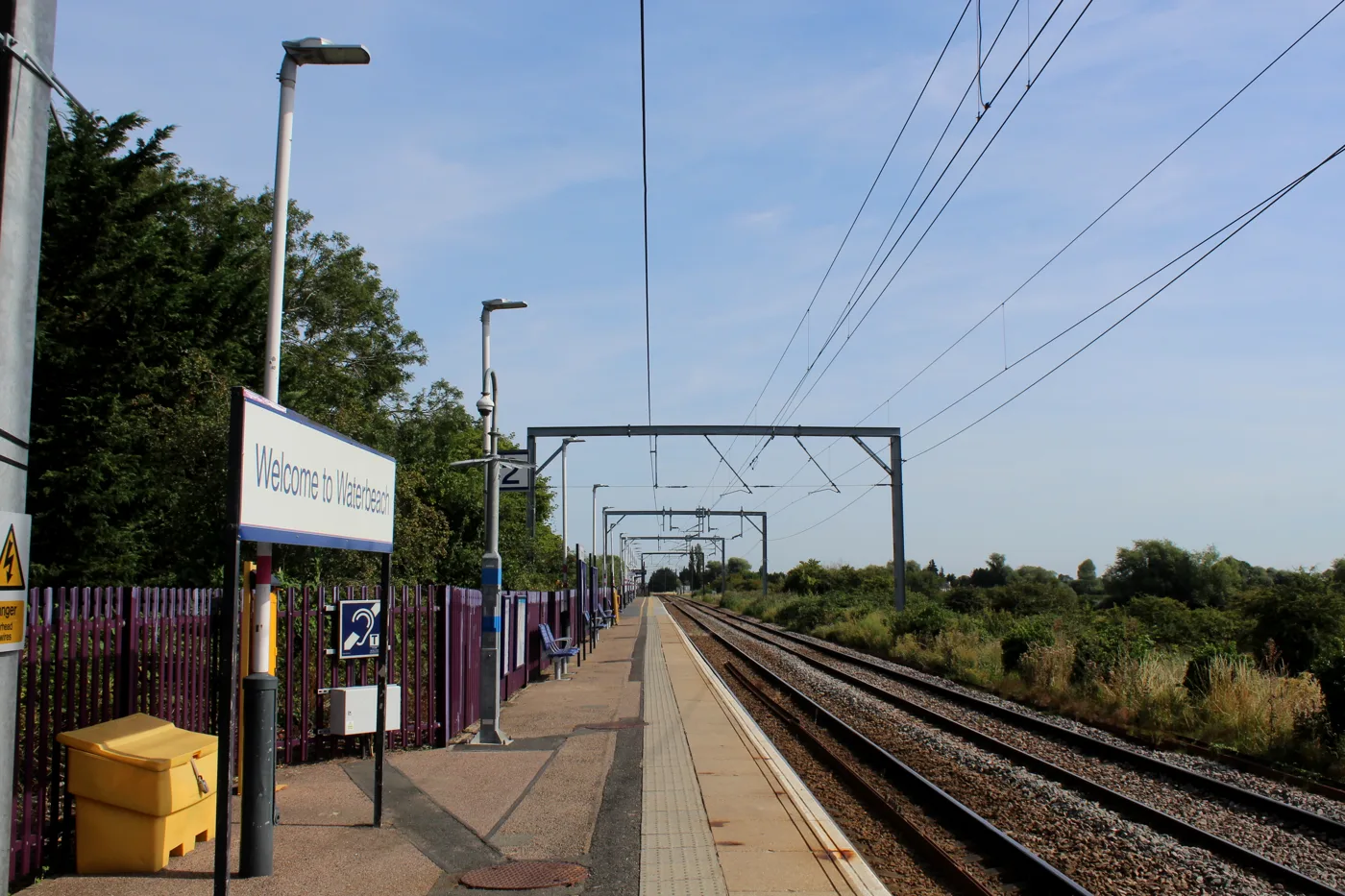

Waterbeach recorded 371,828 entries and exits in 2024-25, a five-year high and only 1.5% below its last pre-Covid year, as work starts on its replacement.
Waterbeach station recorded 371,828 entries and exits in 2024-25, its highest figure in five years. That is the Office of Rail and Road’s estimate, published in its annual station usage series.
The number matters because the station is being replaced. Construction of a new station north of the village starts this autumn, and the existing one is expected to close once the new one is running.
Two findings come out of the official record, and neither is in the version of this argument that usually gets aired.
- Use is recovering fast. 2024-25 was up 12.1% on the previous year and is now only 1.5%, or 5,832 entries and exits, below the last full pre-Covid year.
- The business case for the new station was written on older, lower numbers. Its most recent year was 2022-23. Use has risen 20.3% since then, and the station has already passed a figure the business case did not expect the existing site to reach until 2027.
Thirteen years of Waterbeach station, from the official count
The full series from the ORR’s station usage tables runs like this. A single return journey counts twice in these figures, once as an entry and once as an exit.
| Year | Entries and exits |
|---|---|
| 2016-17 | 440,142 |
| 2017-18 | 430,050 |
| 2018-19 | 407,650 |
| 2019-20 | 377,660 |
| 2020-21 | 100,176 |
| 2021-22 | 265,180 |
| 2022-23 | 309,130 |
| 2023-24 | 331,764 |
| 2024-25 | 371,828 |
The station is still 68,314 short of its 2016-17 peak, a gap of 15.5%. Against the last full year before the pandemic it is within 1.5%.
For scale inside the district, the same table gives Whittlesford Parkway 454,262 in 2024-25, Meldreth 245,846, Shepreth 109,514 and Foxton 98,982. Waterbeach is the second busiest of the village stations.
What happened last time a new station opened nearby
The three years of decline on the chart are not a mystery, and the official case for the new station says so itself.
The Greater Cambridge Partnership’s outline business case, dated 13 May 2024, sets out the same ORR series and draws a blunt conclusion:
In May 2017 Cambridge North station opened and this coincides with the beginning of the decline in Waterbeach’s usage. Cambridge North is just under 5km from Waterbeach station. Cambridge North has a significantly better service offer than Waterbeach and has undoubtedly abstracted some demand from Waterbeach.
The document adds that Waterbeach’s use fell in each of the two full years before Covid while rail use across the Eastern Region rose 1.7% and then 2.6%.
Cambridge North’s own figures show where those passengers went. It recorded 488,876 entries and exits in its first part-year, 2017-18. In 2024-25 it recorded 1,459,946.
What the official forecast actually says
The business case models two futures, one where the station stays where it is and one where it moves. Its forecast years are 2027, 2030, 2040 and 2050. It assumed the new station would open in 2027.
| Forecast year | If the station stays | If the station moves |
|---|---|---|
| 2027 | 387,068 | 437,084 |
| 2030 | 452,787 | 545,108 |
| 2040 | 683,714 | 976,506 |
| 2050 | 774,561 | 1,174,036 |
Three things follow from the document’s own numbers.
- It does not forecast a fall from the move. Even the local catchment component, the trips made by people already living and working nearby, is forecast higher at the new site than the old: 387,694 against 364,541 in 2027.
- Almost all the difference by 2050 is the new town, not the relocation. The gap of 399,475 trips comes mainly from the development itself, which the document says eventually generates more demand than the existing local catchment.
- Reality is already running ahead of the baseline. The most recent year in the business case is 2022-23, at 309,130. Actual use in 2024-25 was 371,828, which is 7,287 above the local catchment figure the document forecast for the existing station in 2027, and within 15,240 of its total 2027 forecast for that site.
None of that settles the argument. It does mean the forecasts were built on a starting point the station has since passed.
The document is open about who loses
The business case does not claim the move suits everyone. It says the modelling “acknowledges that there are ‘winners and losers’ from relocating the station”, and that it assumes people are less likely to use rail the further they live from a station.
On the detail that matters most to the village, it is explicit:
There are people living within 800m (traditionally thought of as the ‘walk-in’ catchment) of the existing station that will be further away from the new station. Those people living in the northern parts of Waterbeach village will be broadly equidistant from the existing and new stations.
Parking is the other pressure point
The existing car park has 83 spaces and is run by APCOA. The new station is to have 200.
The business case is candid about what happens now:
Some users of the station currently park in village streets either due to the car park being full or to avoid paying the charges. This has led to tensions within the village.
Its own modelling expects daily demand at the existing site to reach 83 spaces by 2040, and says the current car park is “likely to reach maximum capacity” on Tuesdays, Wednesdays and Thursdays, when commuting demand peaks. At the new station it expects 82 spaces used in 2027 rising to 199 by 2050.
Where the new station goes, and when
The new station serves Waterbeach New Town, on the former barracks site. The business case puts the centre of the new town 1.25km north of the village, and describes the existing station as about 1.25km south of the new town.
From the Greater Cambridge Partnership’s scheme page and FAQs, read today:
- A temporary haul road is finished, built by Winvic Construction and funded by Homes England, so construction traffic comes off the A10 rather than through the village.
- Spencer Rail Engineering is designing and building the station. Construction is set to start in autumn 2026, with the GCP expecting it complete by early 2028 and the station open by summer 2028.
- The station will have wider platforms, an accessible footbridge and lifts, 100 cycle spaces and electric vehicle charging points.
- It costs £37 million. The GCP is putting in £20 million and Homes England the other £17 million, which the developer is to repay.
- The existing service pattern “is not expected to change”.
- The new town is planned at 11,000 homes and about 25,000 people. The business case puts Waterbeach’s current population at 6,525 in 2,785 households, so the development would raise it by around 400%.
The closure is a separate decision, and it has not been taken
This is the part most easily lost. The GCP is building the new station. It is not the body that closes the old one.
The partnership’s own FAQ says the Department for Transport will hold a consultation on whether to close the existing station, and its scheme page says any closure “would not take place until the new station is operational”.
So there is a statutory process still to come, and a consultation with it. We have seen no announcement of a date for either.
What it means for you
- The existing station is open, and busier than at any time since 2019-20. Nothing changes on the ground this year.
- If you walk to the station from the south or the middle of the village, the official case accepts you will be further from the new one. If you live at the north end, it puts you at roughly the same distance from either.
- If you drive and park, the new station has 200 spaces against 83, and the business case expects the existing car park to be full on midweek commuting days.
- The closure consultation is the moment to have your say, and it is run by the Department for Transport, not the Greater Cambridge Partnership. It has not opened yet.
- Trains are not expected to change, according to the GCP’s own answer on service patterns.
For the current picture on getting about the district, our roadworks and travel page is updated every week, and our trains page has the journey times from each South Cambs station. Planning decisions behind the new town are tracked on our planning news page.
Have your say