
A third wave added 12,700 Greater Cambridge homes on 24 August, taking the total past 60,500. A fourth is due by the end of 2026, after the 31 March legal date.
Almost 12,700 more homes across South Cambridgeshire and Cambridge started weekly food waste collections in the week beginning Monday 24 August. That takes the total to more than 60,500 households on the service. (South Cambridgeshire District Council, 17 August 2026)
It is the third of four waves, and the fourth has no published date beyond “the end of 2026”. If you are still putting food scraps in your black bin, you are in that last group.
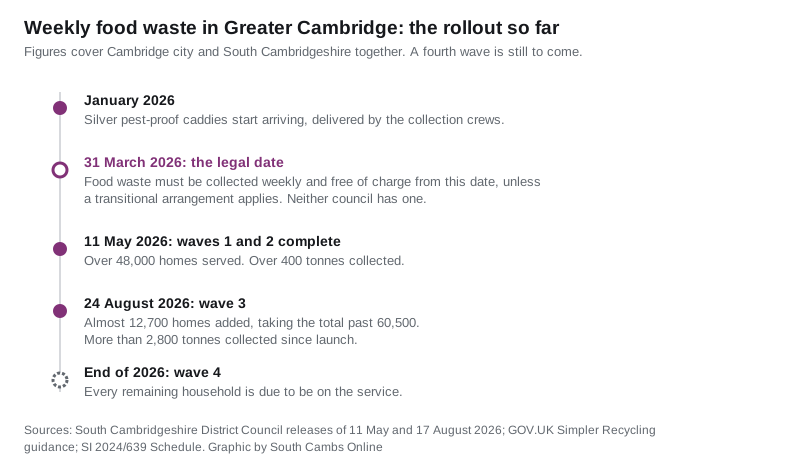
The legal date was 31 March
Weekly food waste collection is not a local choice. Under the government’s Simpler Recycling rules, “food waste must be collected weekly and free of charge”, and councils had to meet the household requirements “from 31 March 2026, unless there is a transitional arrangement in place”. (GOV.UK, Simpler recycling: household recycling in England)
Thirty-one waste collection authorities in England were given a later date for household food waste. They are named in the Schedule to the Environment Act 2021 (Commencement No. 9 and Transitional Provisions) Regulations 2024, which regulation 6 applies to homes. (legislation.gov.uk, SI 2024/639, regulation 6 and the Schedule)
The dates in that Schedule run from 1 June 2026 for Blackburn with Darwen to 1 February 2043 for North Yorkshire. Neither Cambridge City Council nor South Cambridgeshire District Council appears on it. Nor does either appear in the two commencement regulations made since, in 2025 and 2026, neither of which adds any authority.
So the two councils are working to their own timetable, five months past the national date, and without a formal extension.
Greater Cambridge Shared Waste Service runs collections for both. It has explained the phasing in its own terms. The service is being introduced in waves “to ensure new lorries and teams are in place”, and, as it put it in May, “with the whole of the UK introducing changes at the same time this is a major operation”. It said then that it was recruiting 70 new staff for the rounds. It is still advertising for HGV drivers and loaders now. (South Cambridgeshire District Council, 11 May 2026)
What has been collected so far
The tonnage has climbed steeply as the rounds have expanded:
- 11 May 2026: over 48,000 homes on the service, over 400 tonnes collected
- 17 August 2026: more than 60,500 homes, more than 2,800 tonnes collected
That is roughly 2,400 tonnes more in the 14 weeks between the two announcements, on an increase of about 12,500 households. The headroom is still large. Bode Esan, head of climate, environment and waste at the shared service, said in May that 88% of the area’s household food waste had been going into black bins and on to landfill before the scheme started.
The material goes to anaerobic digestion plants at Baldock, March and Thetford, where the gas given off is burned to generate power and what is left becomes biofertiliser for farmland.
What it means for you
The councils have not published a street-by-street or village-by-village list of which homes are in which wave. There are three ways to find out where you stand:
- A letter. The service writes to households before their collections begin. Its own site says that if you had a letter naming the week beginning 24 August, your collections started that week.
- Your bin calendar. Food waste dates appear on the collection calendar for your address once the service starts.
- The postcode check. The “In My Area” box on the Greater Cambridge Shared Waste food waste page reports when the service starts for your address.
Two practical points from the service itself. Caddy deliveries were still going on as of this week, so a missing caddy can be reported rather than waited out. And the caddy takes more than most people expect: tea bags, banana skins and onion skins all count, alongside plate scrapings, bones and out-of-date food.
Nothing about the food waste rollout changes when your other bins are emptied. Our South Cambs bin collection days page explains the black, blue and green cycle and how to check your own address, and we confirmed separately that no round moved for the August bank holiday.
Have your say